Why we invested in 8Layers
Why we invested in 8Layers
Identity has become cybersecurity's hardest problem, and AI just made it exponentially harder.
The reason is structural: the perimeter is gone. Companies today run on hundreds of cloud services, thousands of human accounts, and a fast-growing population of non-human identities: service accounts, API keys, OAuth tokens, and now autonomous AI agents. In a typical enterprise, machine identities already outnumber humans by 50 to 1, and agentic AI is accelerating that ratio every quarter. Every agent an enterprise deploys is a new identity with credentials, permissions, and access to critical systems. Agents spawn sub-agents, chain API calls, and act at machine speed. Most organizations can't even inventory them, let alone govern them.
Attackers noticed first. Roughly three out of four breaches today involve compromised credentials or privilege abuse, and the largest incidents of recent years, fromMGM to Change Healthcare to the Snowflake customer compromises, all share thesame root: identity. Attackers no longer break in. They log in. Andincreasingly, what logs in isn't human. Once inside, the earliest stages of an identity kill chain (reconnaissance, lateral movement, privilege escalation) happen exactly where endpoint and log-centric tools go blind.
The industry's answer has been more fragmentation: IAM here, PAM there, an ISPM point solution, an ITDR add-on, and a compliance team working from spreadsheets. But this is not a vendor problem; it is an architecture problem. Today's identity and detection stacks were architected for a world of employees logging into web apps. You cannot bolt an agentic future onto them. You have to build for it from the start. Meanwhile, European regulation (NIS2, DORA, ENS) is turning identity governance from a best practice into a legal obligation, audited continuously, and regulators are starting to ask who governs the agents.
That combination of a new control plane under attack, an agentic identity explosion, legacy architectures, and regulatory pressure is exactly the kind of market shift we look for.
It's why we invested in 8Layers.
Our conviction starts with the team.
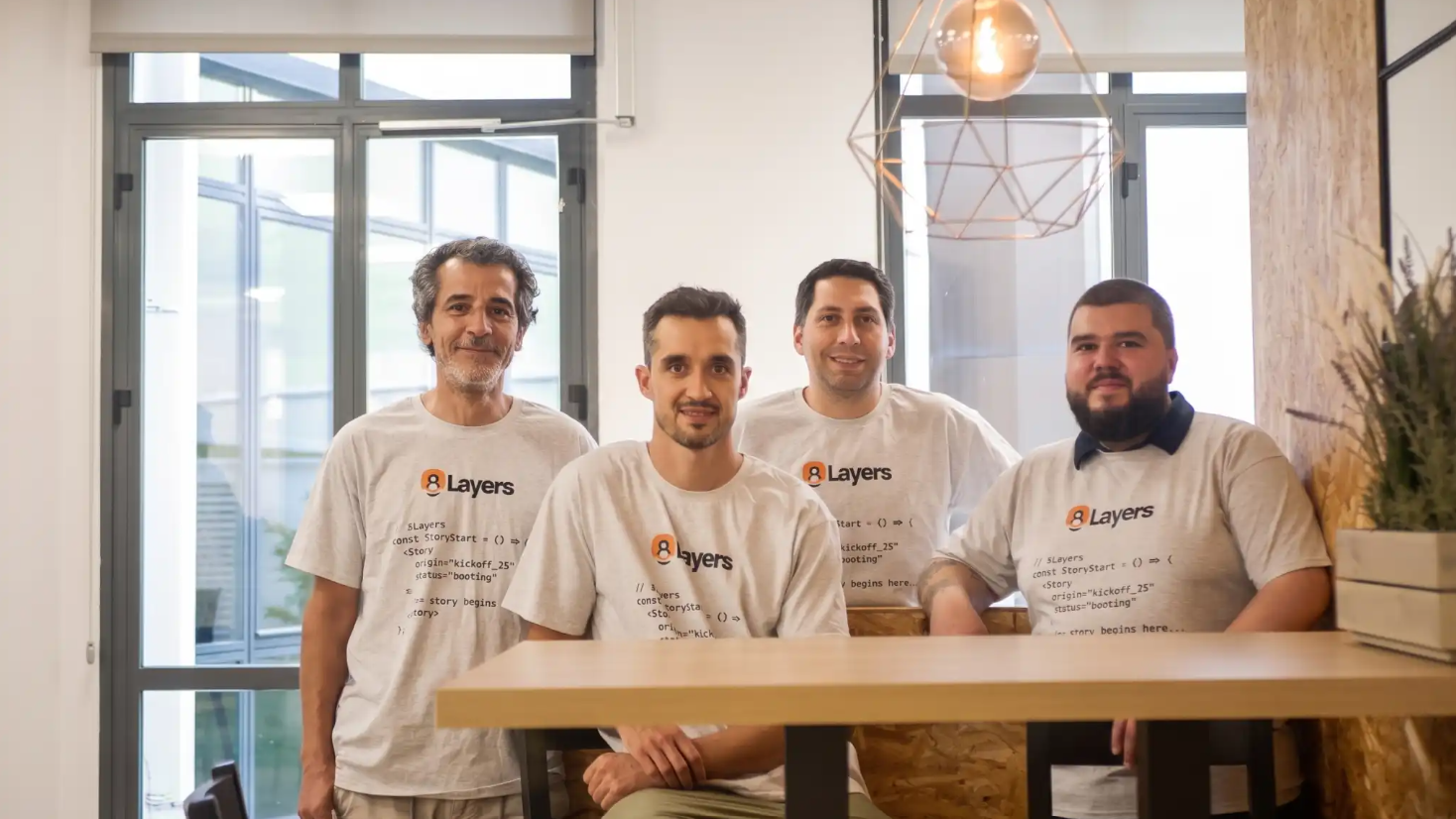
The four founders, Daniel García, Pedro Palao, Iago Salgado, and Pablo Carretero, are core alumni of Devo, the Spanish cybersecurity and data platform that scaled to nine-figure revenue and a $2B valuation. Between them they led engineering, data infrastructure, systems, and threat research at Devo, and most of the current team followed them from there.
This matters for a specific reason: securing an agentic enterprise is, at its core, a data and AI problem. Every sophisticated detection requires correlating massive volumes of signals from wildly heterogeneous sources (IdPs, cloud workloads, logs, external enrichment) over long time windows, and feeding that context into models that can separate legitimate agent behavior from an attack in progress. This team has spent more than a decade building exactly that kind of infrastructure at enterprise scale. Few founding teams in Europe, or anywhere, can claim the same.
The product reflects that DNA.
8Layers takes a different approach: unifying ISPM, ITDR and continuous compliance on a single shared identity data layer, covering human and non-human identities alike, from service accounts to AI agents.
That integration is not cosmetic. The same identity inventory that powers detection generates audit evidence; a risk accepted in posture management is automatically reflected in compliance reporting; a compliance drift triggers a security alert. Detections are context-aware, enriched by ML models operating over the full identity graph, and response is automated: rules can suspend an identity, revoke sessions, or isolate a compromised agent without an analyst in the loop. That last part matters, because attacks that move at machine speed cannot wait for human triage.
And because the root problem is architectural, the team is rebuilding the foundation itself: a proprietary, graph-based, self-shaping database that observes usage patterns and adapts its own structure, designed for the continuous, long-context correlation that identity detection and AI models demand and that conventional architectures handle poorly. It is an ambitious, multi-year bet, and it is the long-term moat.
There's also a European angle we think is under appreciated. Compliance with ENS, NIS2,and ISO 27001 is native to the platform, not retrofitted from a generic playbook. As European regulation becomes a direct demand catalyst, and as AI governance frameworks extend those obligations to agentic systems, being built for it from day one is a real go-to-market advantage.
Every great cybersecurity company sits at the intersection of three things: an urgent problem, a structural market shift, and a team uniquely built to solve it.
The problem is urgent: identity is the number one attack vector, and the agentic AI wave is multiplying the surface faster than organizations can govern it.
The shift is real: ISPM, ITDR and non-human identity security are emerging categories with no established winner, and both AI adoption and European regulation are pulling demand forward.
And the team is exceptional: operators who have already built and scaled category-defining security data infrastructure, now rebuilding the identity layer for the agentic enterprise.
That's why we're proud to back Daniel, Pedro, Iago, Pablo, and the 8Layers team as they build the identity security platform for the AI era.
Workforce Identity Security landscape and where 8layers sits.
The identity security market is fragmented across dozens of subsegments, fromaccess management and IGA to PAM, NHI, and detection. We mapped it ourselves to see where the real gaps are and where 8layers fits.
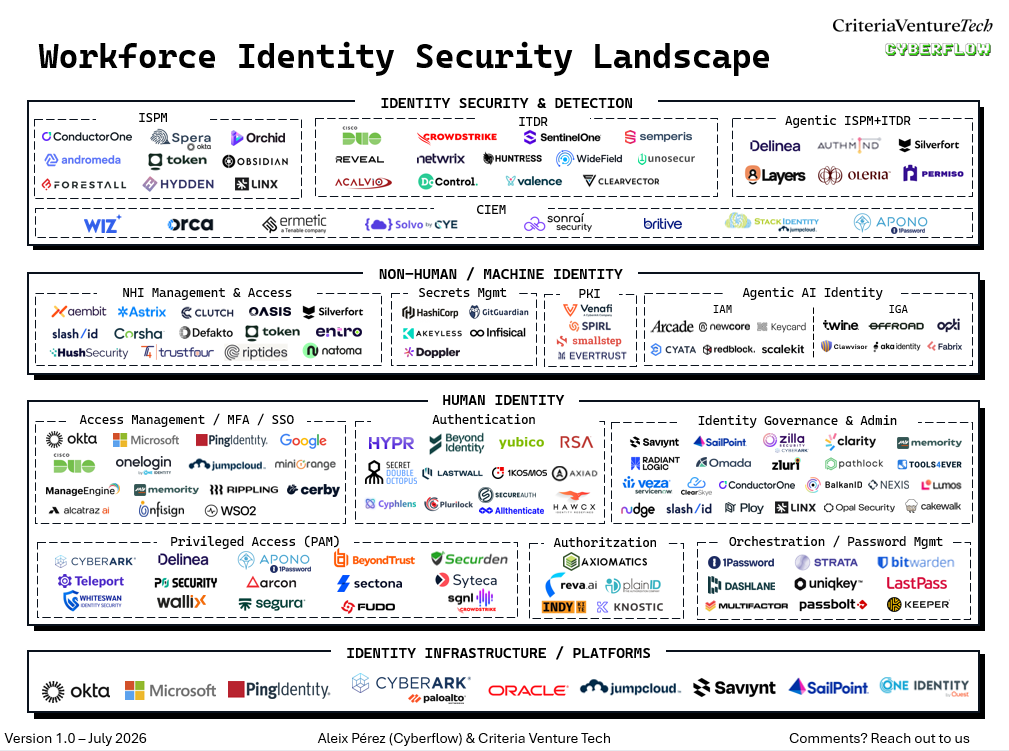
8Layers sits at the intersection of ITDR and ISPM, with an agentic-native architecture from day one. That is the corner of the map where legacy vendors are still bolting AI onto old platforms, and where cloud-first challengers are still stuck on posture without real-time response. It is nearly empty, and it is where the market is heading.
Learn more at 8layers.io.